
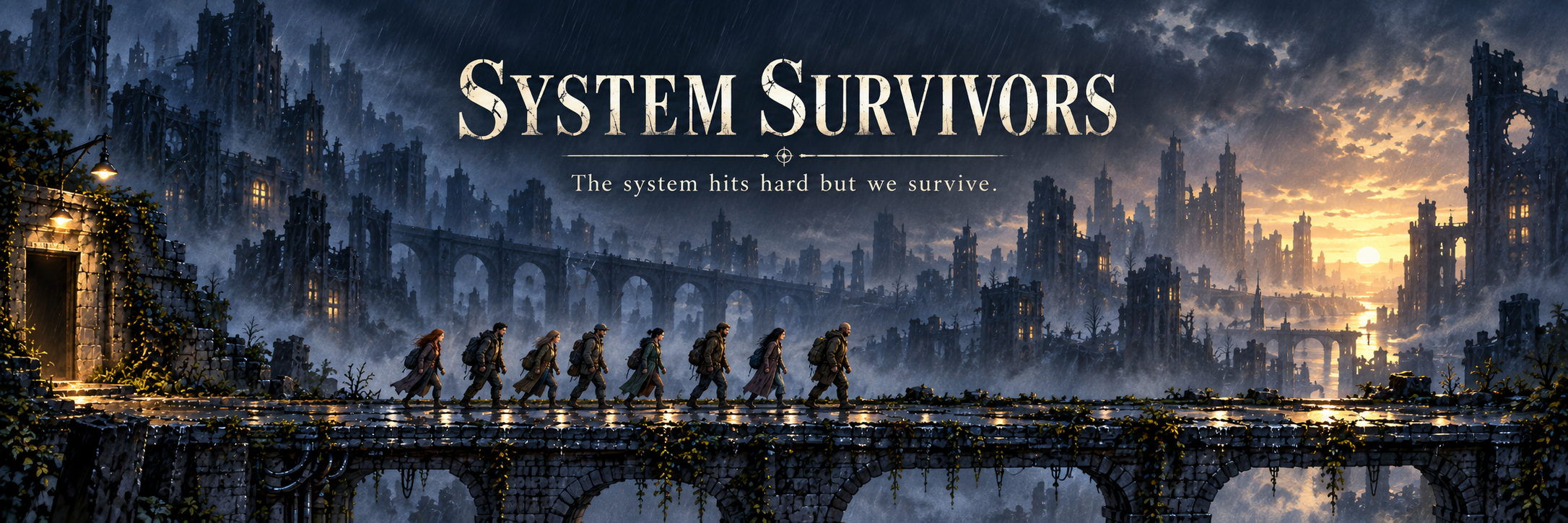
System Survivors is a psychological crowd puzzle-platformer built around a troubling instruction: an unseen authority tells a moving group who must be left behind. The presentation frames the journey around obedience, connection and survival. Early puzzles make sacrifice appear necessary, while the longer narrative asks players to question those rules. Its intended destination is empathy and hope, with symbolic rather than graphic loss.
The playable foundation gives the player a group that walks automatically. Instead of steering every step, the player observes the terrain, selects a survivor, issues a limited command or activates a mechanism. Wait, Follow and Turn sit alongside switches, relay holding, exits and population objectives in the documented slice. Quick retries make it possible to investigate the consequences of a decision.
Survivors are intended to become more than anonymous units. The artwork includes eight distinct appearances, while planned memories reveal names, hopes and relationships over time. Mara and Eli form a central parent-child story in the narrative plans. These relationship systems belong to the development direction and should not be mistaken for a completed campaign.
The visual work uses layered environments to give the two-dimensional world depth. Rain, fog and a ruined city establish the distance, while a campsite and nearby rocks and foliage shape the foreground. Individual survivor rigs and an animation preview screen support character development. The presence of animation clips does not mean that future combat or traversal systems are already playable.
The planned campaign spans nine chapters and 90 registered level slots, progressing from The March to The Dawn. Only three playable levels are documented in the current slice, with the remaining 87 planned. Later chapters, alternate outcomes and the final refusal sequence are narrative goals. The presentation also notes that build status comes from development records because the original project folder was unavailable during its preparation.
The next milestone is a complete first chapter, starting with clearer interactions, animation transitions and puzzle readability. Later work includes richer relationships, more traversal systems and full ending sequences. Accessibility features such as remapping, scalable text and reduced motion remain goals in the presentation. NodeRealm will share progress without presenting those plans as finished features.